Stop charging by the hour
Why hourly rates cap your income, and how to package your work into offers clients say yes to.
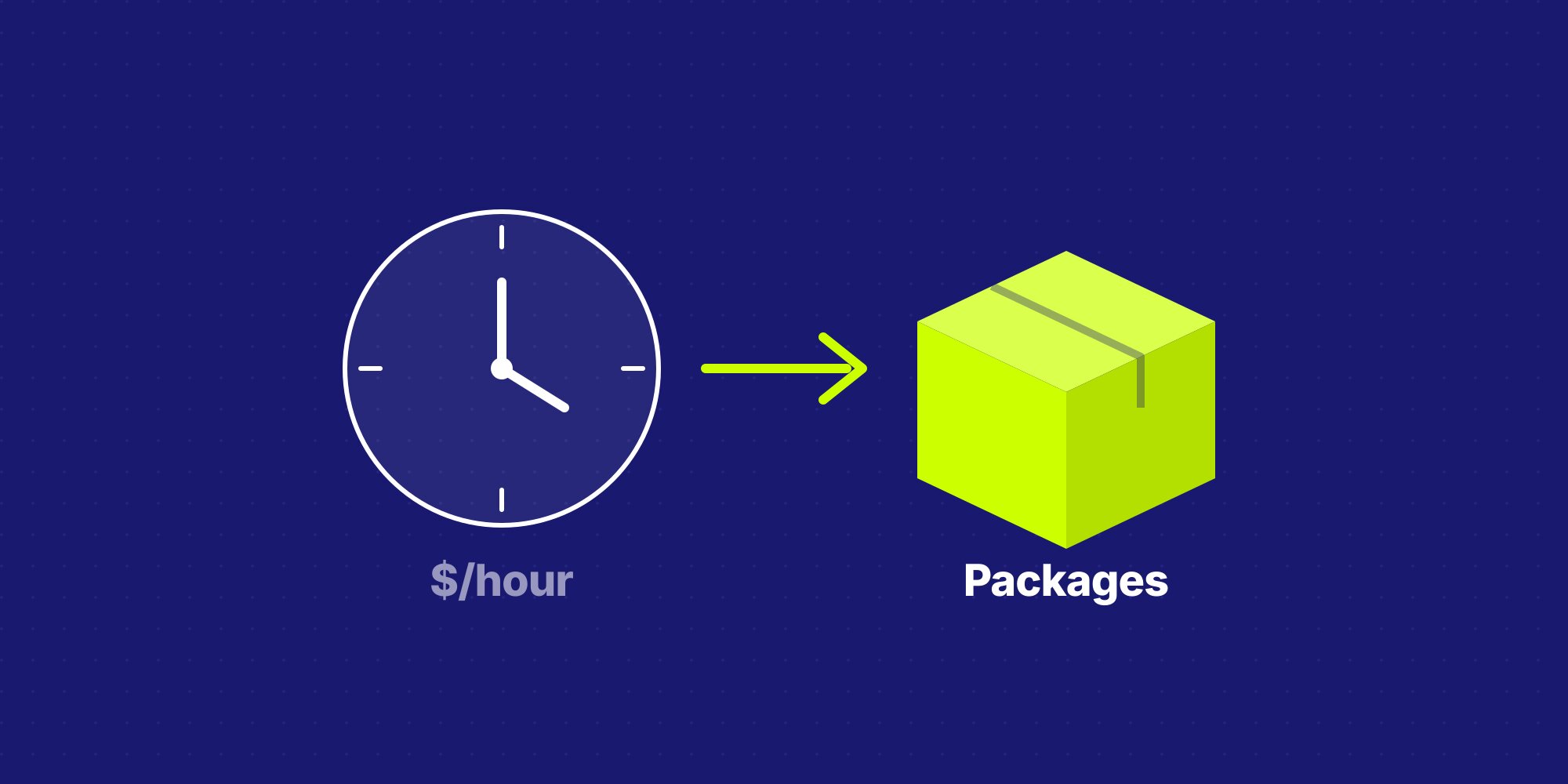
Charging by the hour feels fair. It’s simple, it’s what most of us were paid in a job, and it’s easy to explain.
It’s also the fastest way to build a side hustle that never grows.
If you have 10 spare hours a week and charge $60 an hour, the most you can ever earn is $600 a week. That’s before admin, quoting, travel and the hours nobody pays for. The only ways up are working more hours, which you don’t have, or putting your rate up, which feels scary every single time.
There’s a better way, and it’s the one most established small businesses already use. You stop selling hours and start selling packages.
Why hourly rates hold you back
The hours ceiling is the obvious problem. But there are four quieter ones that do just as much damage.
You get punished for getting better. The first logo you design might take 12 hours. The fiftieth might take four. You’re faster, more skilled and doing better work, and you earn a third of what you did. Hourly pricing rewards being slow.
Clients start watching the clock. When they’re paying by the hour, every phone call, email and revision feels like money ticking away. They hold back questions, push you to rush, and query your timesheet. That’s not a great working relationship for either of you.
You get compared to a wage. Say “$75 an hour” and people quietly compare it to what they earn at work. They forget you pay your own tax, ACC, KiwiSaver, software, equipment and holidays. A rate that’s fair for a business sounds expensive next to a salary.
The client can’t budget. “It depends how long it takes” is an uncomfortable answer when someone’s trying to decide whether to hire you. Uncertainty slows people down, and slow decisions often turn into no decision.
What to sell instead: a package
A package is a clearly defined piece of work, for a fixed price, that gets the client a result they care about.
Instead of “website design, $70 an hour”, you offer “a five-page website, live in three weeks, $2,400”. Instead of “bookkeeping, $55 an hour”, you offer “your books done every month, GST returns filed, $350 a month”.
The client knows exactly what they’re getting and what it costs. You know exactly what you’re delivering. And the price is now tied to the value of the result, not the minutes it took you.
There are three common shapes:
- A fixed-scope package. One defined job, one price. Good for projects with a clear end: a website, a brand kit, a garden makeover, a bathroom tile job.
- A monthly package. The same work, done every month, for a set fee. Good for anything ongoing: bookkeeping, social media, cleaning, lawn mowing, IT support.
- A tiered offer. Three versions of the same package at three prices, so the client chooses how much they want rather than whether to hire you at all.
How to build your first package
You don’t need to repackage everything at once. Start with the thing clients ask you for most.
- Name the result, not the task. Clients don’t want “10 hours of social media”. They want a feed that looks active and brings in enquiries. Start with what they’re actually trying to get.
- Write down what’s included. Be specific: how many pages, posts, revisions, visits or calls. Then write down what’s not included. This is what stops scope creep before it starts.
- Work out your floor price. Estimate how many hours it really takes, including emails and admin. Multiply by the hourly rate you’d need to make it worthwhile, then add 20% for the job that runs long. That’s the lowest you should ever charge.
- Check it against the market and the value. What do others charge for something similar? What’s the result worth to the client? If a new website brings a tradie two extra jobs a month, $2,400 is a bargain. Your price can sit well above your floor.
- Give it a name. “The Starter Site” or “Monthly Books” is easier to buy, and easier to talk about, than a list of tasks.
- Add a rate for extras. Anything outside the package gets quoted separately or charged at a set add-on rate. This is where your hourly rate still lives, just not at the front.
A worked example
Mia builds websites for small businesses on the side. She used to charge $70 an hour. A typical five-page site took her around 20 hours, so about $1,400. Clients often pushed back on the final invoice, and every extra round of changes turned into an awkward conversation.
She replaced her hourly rate with three packages:
| Package | What’s included | Price |
|---|---|---|
| Starter | 3-page site, contact form, 1 round of changes, live in 2 weeks | $1,500 |
| Standard | 5-page site, contact form, basic SEO setup, 2 rounds of changes, live in 3 weeks | $2,400 |
| Plus | Everything in Standard, plus a booking system, Google Business Profile setup and a 30-minute training call | $3,600 |
Prices are plus GST if she’s registered. Extra changes are charged at $90 an hour.
Most of her clients now choose Standard. It takes her about the same 20 hours it always did, but she earns $2,400 instead of $1,400. Clients are happier too, because they know the cost up front and they’re not watching the clock. And as Mia gets faster with each site, she earns more per hour, not less.
“But what if it takes longer than I thought?”
Sometimes it will. That’s what the 20% buffer and the “not included” list are for.
If a job runs over because you underestimated it, that’s a lesson for your next price, not something to bill the client for. If it runs over because the client asked for more, point back to what’s included and quote the extra. Most clients respect that when the scope was clear from the start.
Over time, you’ll get better at estimating. Keep a quick note of how long each package actually takes for your first five or ten jobs. That’s all the data you need to adjust.
When hourly still makes sense
Hourly isn’t always wrong. It works for genuinely open-ended work where nobody can say what’s involved yet, such as fixing an unknown problem or a short consult. It also works as your rate for small extras on top of a package.
The aim isn’t to ban your hourly rate. It’s to stop it being the first thing a client sees.
Your next step
Pick the one service you get asked for most. This week, write it up as a package: the result, what’s included, what’s not, and a price. Then quote it to the next person who enquires, before you mention an hourly rate.
The first time feels uncomfortable. By the third, you’ll wonder why you ever did it any other way.
Want a second opinion on your package or your price? Share it in the Side Hustles NZ Facebook group. It’s full of Kiwis who’ve made the same switch and are happy to tell you what they’d change.